
My Official Response to South Korea's Announcement to End Overseas Adoption
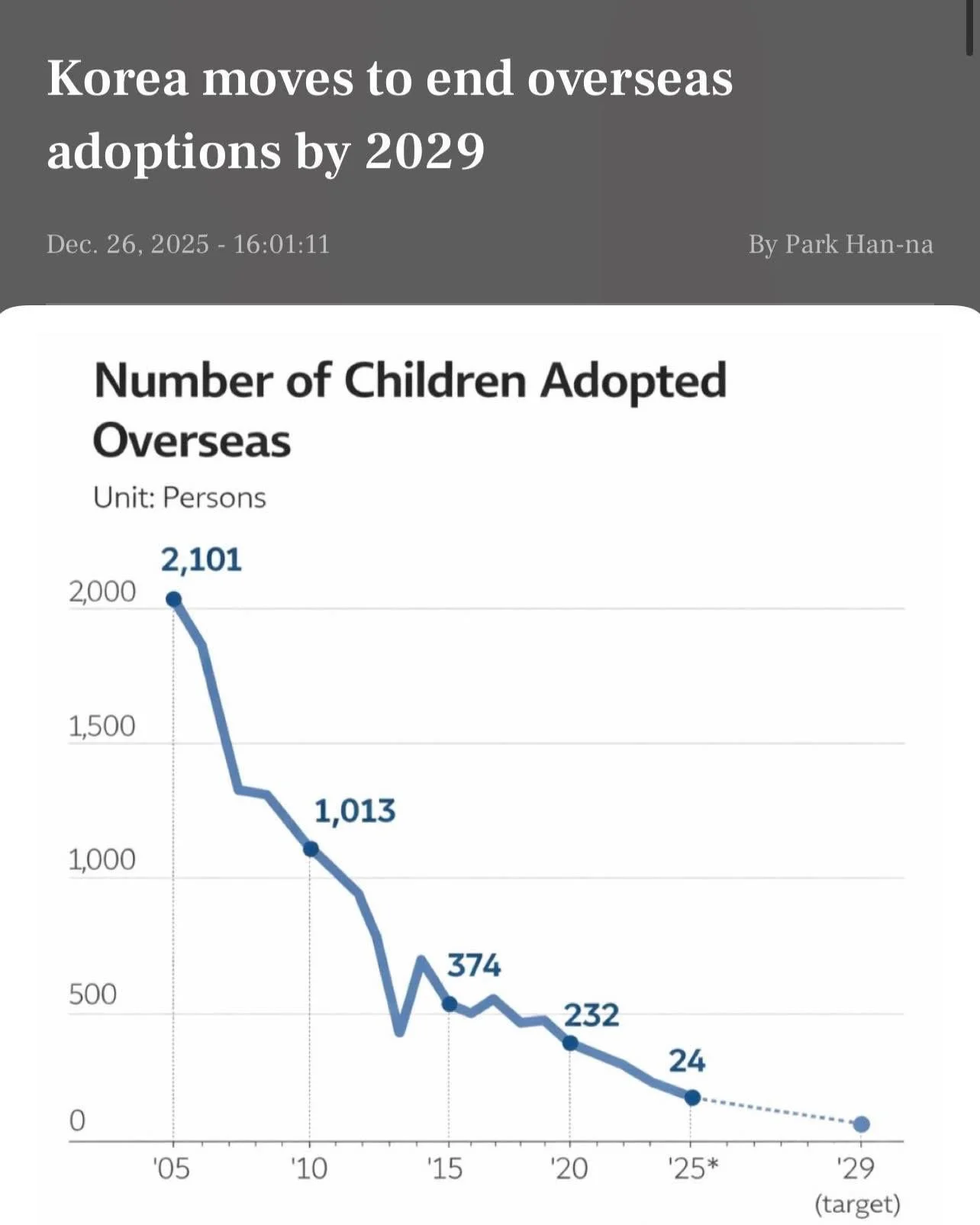
South Korea is a country that has worked hard to recover since the Korea War. It has rapidly become a leading economic power in the world. Historically, Koreans were once united in the fight to become their own sovereignty. They established their own identity against foreign nations. It’s one of the ways I can relate to what it means to be Korean.
Perhaps “exporting” Korean children was both a means for the country to recover economically since the war as well as purge itself of unwanted and mixed race children to further establish their national identity and independence. I am one of the 200,000 Koreans who became a victim in this global child supply market. Despite playing a significant part in restoring my homeland, I am a foreigner among my people. This sacrifice has been a tremendous burden for me.
As an industry, the announcement by the Ministry of Health and Welfare is nothing more than a market shift with the aim of improving the country’s image as well as revitalize its birth rate. It is obvious the goal is primarily to sustain the country’s priority on productivity. This announcement is letting the industry know that South Korea will continue doing business. As a victim of this industry, I am deeply hurt by this news.
“Buying and selling children is still a crime whether it’s committed by private or government agencies.”
Here’s how:
With the clear decline in the international markets, South Korea aims to reprioritize and develop the domestic markets. This is a trend among many other countries. However, the fine print reveals: “Overseas adoptions will be allowed only in exceptional cases.” This is not ending the sale of Korean children as the headline suggests. As an industry, every deal counts.
President Lee Jae Myung stated in October, “the country once carried the shameful label of an exporter of children,” which speaks to the concern over the reputation of an image-conscious nation. As a victim, I hear the message loud and clear: “we care more about how we appear to the global community than about our own people.” Buying and selling children is still a crime whether it’s committed by private or government agencies. The harm done to the children and families is the same.
This announcement is the result of a powerful multibillion dollar criminal industry that promises its stakeholders guaranteed profits well into the future. To a country that continues to be hungry for both economic power and global recognition, it is vulnerable to such an industry.
South Korea has ratified the Hague Adoption Convention, gaining approval of many advocates who were once fighting to abolish the criminal scheme. It aligns with the propaganda that child trafficking is a child welfare solution, wasting no time to promise family reunification to gain further buy-in. As a victim who knows the truth, I’m not buying it, I’m calling it out. My response, “don’t create a whole new generation of victims. Shut it down now.”
This is the same scheme the industry has used for centuries to normalize and legalize these crimes. Child trafficking should not be used as a child protection measure. In fact, iis child abuse, a moral offense. Child trafficking is not a solution to revitalize the birth rate. It is child slavery. Slavery is a crime against humanity. Referring to it as adoption may cover up the crime, but doesn’t erase it. Adoption is merely the fantasy, the illusion. It is a euphemism.
I will not and cannot be brainwashed again. I am deeply saddened and disturbed to see history repeating itself in my homeland. Other countries will follow South Korea’s lead in carrying out this market shift. Last and most importantly, all of this attention on “adoption” takes attention away from the fertility markets positioned to triple and quadruple their profits in the same timeframe as this 5-year plan. While we focus on South Korea’s adoption policy, the industry will continue to grow its other more lucrative markets without significant resistance or scrutiny.
I am not fooled and see right through this ploy. However, I am just one person, one voice, and have been labeled “unpopular” by industry reformists and therefore minimized and ignored. I recognize the industry has won over the entire world and those who once fought to abolish it are now fighting to reform it and keep it going. While I stand apart from the “popular” views on reform, I refuse to be silenced. Millions of lives are at risk. Too many children’s lives have been taken and many more are being threatened.
The line must be drawn here. This must be stopped. Let’s all unite once again to stand up for our identity, our independence against a criminal industry looking to enslave and exploit us all for profit. Let’s stand together against such policies and schemes we know are abusive and harmful to us. As a victim of this industry, I’m asking you to give me hope that you will help shut it down for good. South Korea has suffered enough from the division of its country and separation between its people. To really establish itself as a global leader, South Korea would gain much more approval from its people by not following industry trends, but by setting the example of saying no to buying and selling its own children.
Seeking a way to commit the same crime less shamefully is not the answer, it’s not committing the crime at all that restores trust and honor. If I matter, then make me proud to be Korean.
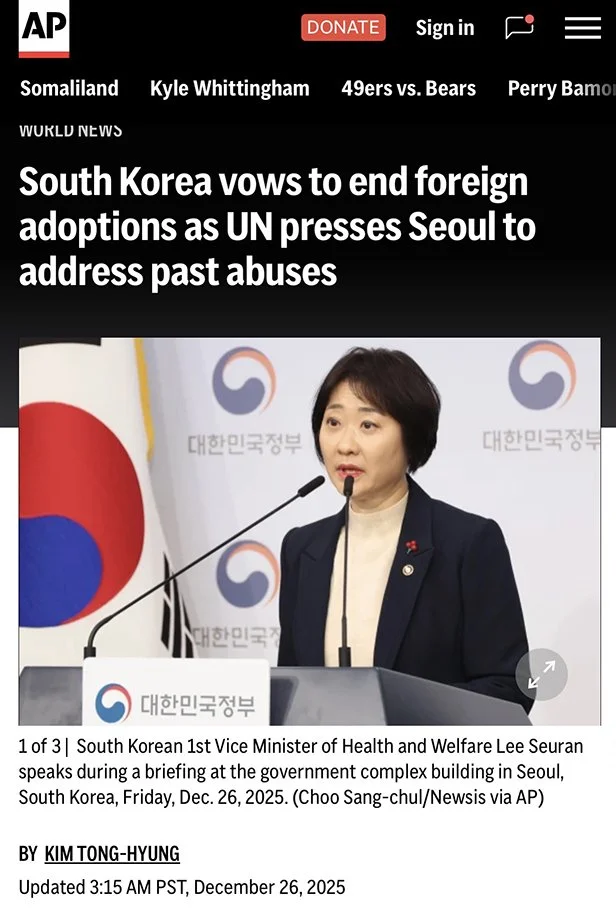
The headline is misleading. Read the fine print “Overseas adoptions will be allowed only in exceptional cases, with procedures handled directly through coordination with foreign governments.” South Korea has been caught with fraud, lies, and deception in hundreds of cases in an investigation by the Truth and Reconciliation Commission. I have no reason to believe or trust anything the government is saying about what it promises to do. Actions speak louder than words.
Let’s be reminded of the apology given to us in 1998 by former president Kim Dae Jung. Yet for nearly 30 years after that apology, the country trafficked 50,000+ more Korean children to other countries. Let’s be clear that falsifying official documents, fraud, and deception such as empty promises are acts of human trafficking. The UN can bring up their concerns, but how can they enforce sanctions against South Korea if even they aren’t willing to call it human trafficking by their own definition!?
According to the UN Office on Drugs and Crime, “human trafficking is the recruitment, transportation, transfer, harbouring or receipt of people through force, fraud or deception, with the aim of exploiting them for profit.” This is virtually the standard operating procedure in every case. More than human rights violations, this is a crime and on a mass scale it is slavery.
The fact people are not calling out these crimes should be a red flag and setting off alarms. For years, state and private agencies have gotten away with taking, trafficking, and killing countless children. South Korea is no exception. In October 2020, Koreans were outraged after the murder of 16 month old Jung-in. Former President Moon responded in early 2021 by giving a statement to buyers that if they didn’t like the child they could return or exchange them. His statement created more outrage and sparked the “I am not a thing” campaign which I had participated in.
The truth is that South Korea has played a key role in developing and growing the global child supply market. It has acknowledged exploiting its own children to recover its economy after the Korean War. There is no reason for it to stop. Pressure from victims, or the UN has not been strong enough to shut down the industry in South Korea. Crimes like human trafficking have only been briefly mentioned in the media and less so now as reform rather than abolishment is being pursued.
“For years, state and private agencies have gotten away with taking, trafficking, and killing countless children.”
Make no mistake, this announcement and plan by the Minister of Health and Welfare is nothing more than a market shift - same business, new management. Such actions already taken by the South Korean government have rendered the apology from October meaningless and disingenuous. As a victim among the 200,000+ I continue to feel like a commodity, treated without respect, dignity, or care as the country I was born in promises to continue victimizing and exploiting more of its children for profit. It has ratified the Hague Adoption Convention. It is not shutting down its international market and instead investing more in its domestic market. These actions speak louder than words.
I am not fooled. I know the truth and am not afraid to call it out. My observations are based in reality backed by evidence and fact. The South Korean government has done nothing to earn my trust in anything it says. Children have been bought and sold to abusers and far too many have died and been killed. What has been done to stop this? I’m not interested in words, I need to see actions. Stop taking, trafficking, and killing children immediately. Stop the supply of children, stop funding the market. That’s the only solution to stopping the murders. If South Korea really is concerned about its birth rate, shutting down the market and stopping the murders should be their top priority. Instead they are keeping it going. Call it out.